
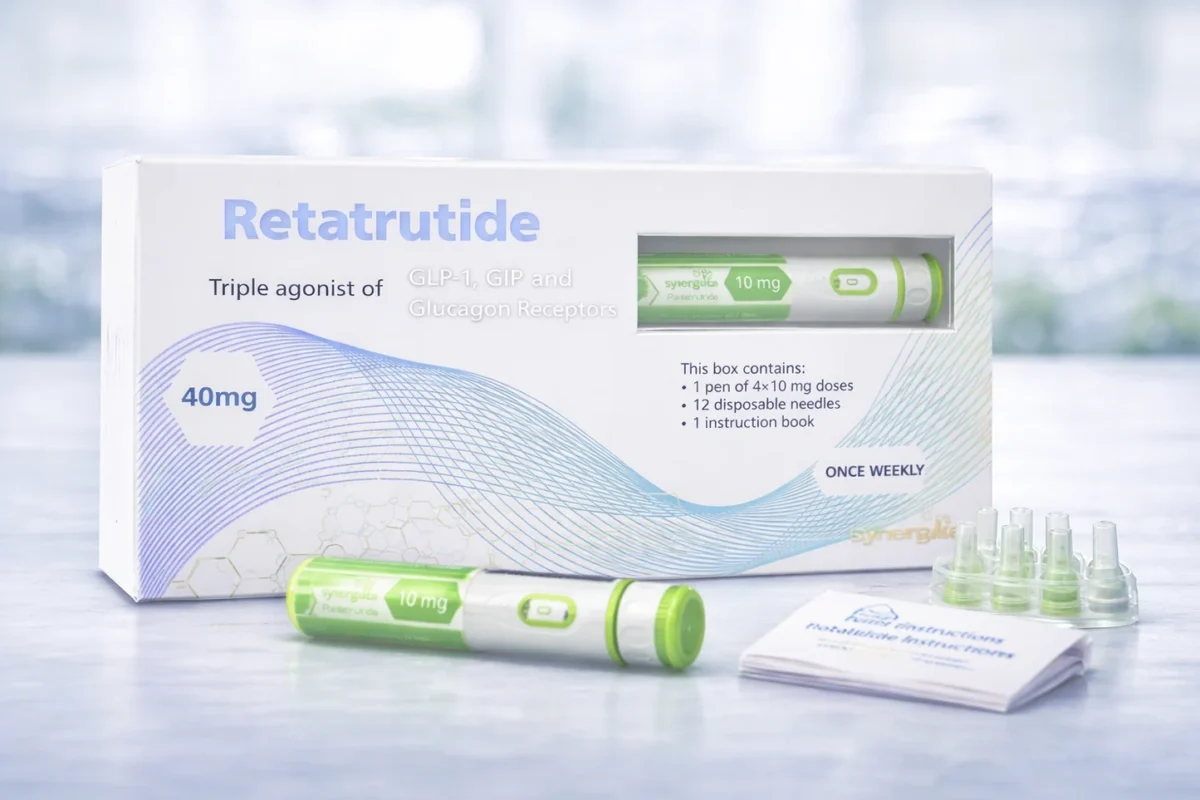
Synedica Retatrutide 40mg Research: Scientific Guide & UK Context
Synedica Retatrutide 40mg research is part of a broader scientific interest in retatrutide, an investigational molecule designed to activate three hormone receptors involved in metabolic signalling.
Retatrutide is being studied as a GIP, GLP-1 and glucagon receptor agonist. Eli Lilly describes it as an investigational once-weekly triple hormone receptor agonist and continues to evaluate it in Phase 3 clinical research.
This guide explains the scientific background behind Retatrutide 40mg research, the three receptor pathways involved, why the compound has attracted research interest, and how a research listing should be distinguished from an authorised medicine.
Research-use notice: This article is for scientific and educational purposes. Research materials discussed here are not presented as medicines or treatments and are not intended for human or veterinary use.
What Is Retatrutide?
Retatrutide, also known as LY3437943, is an investigational peptide-based molecule being developed by Eli Lilly.
Its defining characteristic is its activity across three receptor systems:
- GIP — glucose-dependent insulinotropic polypeptide
- GLP-1 — glucagon-like peptide-1
- Glucagon
Lilly’s current research pipeline describes LY3437943 as a biologic entity acting as a triagonist at the GIP, GLP-1 and glucagon receptors.
This three-pathway mechanism is the central reason Retatrutide has become an important subject of metabolic research.
What Does Synedica Retatrutide 40mg Research Refer To?
The term Synedica Retatrutide 40mg research generally refers to research-oriented information surrounding a catalogue formulation described as containing 40mg total Retatrutide.
The current Synedica Research catalogue lists a:
Retatrutide Triple Agonist Injection Pen Kit — 40mg Total
The current catalogue price is £110, although this page is focused on scientific information rather than pricing.
For current pricing information, researchers can refer to the dedicated Synedica Retatrutide 40mg Price UK resource rather than treating this research article as a price page.
Why Is Retatrutide Important in Peptide Research?
Many metabolic research programmes investigate individual signalling pathways. Retatrutide is notable because its molecular activity involves three receptor systems simultaneously.
The scientific question is therefore not simply what happens when one pathway is activated, but how combined GIP, GLP-1 and glucagon receptor activity interacts within metabolic biology.
Researchers can study areas including:
- receptor signalling
- metabolic regulation
- glucose-related pathways
- energy metabolism
- body-weight biology
- interactions between incretin and glucagon signalling
- structure-function relationships
- downstream cellular responses
The precise biological effects depend on the experimental model, study design and research conditions.
The Three Receptor Pathways
1. GIP Receptor
GIP is an incretin hormone involved in metabolic signalling.
Research into GIP signalling examines its role in glucose regulation and interactions with other metabolic pathways.
Retatrutide’s activity at the GIP receptor therefore forms one part of its broader triple-agonist mechanism.
2. GLP-1 Receptor
GLP-1 is another major incretin-related signalling pathway.
GLP-1 receptor biology has been extensively studied in relation to glucose regulation, gastrointestinal signalling and energy metabolism.
Retatrutide combines GLP-1 receptor activity with GIP and glucagon receptor activity rather than functioning solely through the GLP-1 pathway.
3. Glucagon Receptor
Glucagon is involved in metabolic processes including regulation of energy availability and glucose metabolism.
Retatrutide’s glucagon receptor activity adds a third component to its molecular profile.
The combination of these three receptor activities is what distinguishes Retatrutide from compounds designed around fewer receptor targets.
Retatrutide 40mg Research: Why the Amount Matters
When reading a research-product listing, the stated amount is an important specification.
A 40mg total listing describes the amount stated for that particular catalogue formulation. It does not, by itself, establish:
- clinical efficacy
- safety
- therapeutic suitability
- regulatory approval
- human-use instructions
- an appropriate research protocol
The numerical amount should therefore be treated as a product specification, not as a medical recommendation.
Researchers comparing products should distinguish between total material quantity, formulation, analytical documentation and the scientific requirements of their experiment.
Current Retatrutide Research Status
Retatrutide remains an investigational compound.
Lilly’s current pipeline lists Retatrutide in Phase 3 development for obesity, knee osteoarthritis pain and obstructive sleep apnea, with additional clinical research programmes described by the company.
In July 2026, Lilly reported additional Phase 3 results from TRIUMPH-2 and TRIUMPH-3 and stated that it planned to submit a Biologics License Application to the FDA in Q1 2027. Those statements concern Lilly’s clinical-development programme and should not be interpreted as existing marketing authorisation.
Lilly’s current public information also states that Retatrutide is not yet available for public use.
Retatrutide Research in the UK
UK researchers should distinguish between scientific research and medicinal authorisation.
A compound can be the subject of extensive clinical and laboratory research without being authorised as a medicine for general public use.
The Synedica Research website specifically states that Retatrutide is not authorised for use as a medicine in the UK and presents its research materials as laboratory-use information rather than medical products.
This distinction is particularly important when evaluating online information about Retatrutide.
How to Evaluate Retatrutide Research Information
A useful research evaluation process starts with the scientific question rather than the product name.
Check the molecular identity
Confirm that the research material is described consistently and that the compound being discussed corresponds to the intended research target.
Review the formulation
Look at the stated total quantity, formulation and available product documentation.
Examine the scientific literature
For biological conclusions, prioritise peer-reviewed research and clinical-trial information rather than relying exclusively on supplier descriptions.
Separate research findings from marketing language
A supplier’s product description and a peer-reviewed scientific result serve different purposes.
Scientific conclusions should be based on appropriate experimental evidence.
Check regulatory status separately
Research activity does not automatically equal medicinal approval.
For current regulatory information, consult the relevant UK and international regulatory sources.
Retatrutide 40mg Research vs Clinical Research
These terms should not be confused.
Retatrutide 40mg research product refers to a catalogue material described for research purposes.
Clinical Retatrutide research refers to controlled studies involving investigational Retatrutide under formal clinical research protocols.
Lilly’s clinical trials are part of the latter category.
The existence of clinical research does not automatically validate every commercial product marketed online under the Retatrutide name.
What Can Researchers Study?
Depending on the laboratory model and research objective, Retatrutide-related research can involve several scientific areas.
Receptor pharmacology
Researchers can investigate how multi-receptor activity influences cellular signalling.
Metabolic biology
The interaction between GIP, GLP-1 and glucagon pathways provides a model for studying integrated metabolic signalling.
Structure-function research
Researchers can investigate how molecular characteristics relate to receptor activity.
Cellular signalling
Experiments can examine downstream signalling responses following receptor activation.
Translational research
Clinical research can investigate how findings from molecular and preclinical studies translate into outcomes in defined study populations.
These are distinct research areas and should not be conflated with claims about individual medical treatment.
Current Synedica Retatrutide 40mg Catalogue Information
The current Synedica shop lists several Retatrutide-related products, including:
| Catalogue listing | Stated information |
|---|---|
| Retatrutide Triple Agonist Injection Pen Kit | 40mg total |
| Retatrutide 40mg Bulk Price | Separate bulk listing |
| CagriReta Dual Pen Kit | 4mg Cagrilintide + 40mg Retatrutide |
The catalogue currently lists the standard 40mg Retatrutide pen kit at £110 and the separate bulk listing at £130–£6,200.
These are catalogue details rather than scientific conclusions about efficacy or clinical use.
Frequently Asked Questions
What is Synedica Retatrutide 40mg research?
It refers to research-oriented information concerning a catalogue formulation described as containing 40mg total Retatrutide. Retatrutide itself is an investigational triple-receptor agonist involving GIP, GLP-1 and glucagon pathways.
What are the three receptors targeted by Retatrutide?
Retatrutide is designed to activate the GIP receptor, GLP-1 receptor and glucagon receptor.
Is Retatrutide a GLP-1?
Retatrutide has GLP-1 receptor activity, but it is more accurately described as a triple GIP/GLP-1/glucagon receptor agonist rather than a GLP-1-only compound.
Is Retatrutide approved in the UK?
Retatrutide is not currently authorised as a medicine in the UK. The Synedica Research website identifies it as an investigational compound, while Lilly continues to describe it as an investigational molecule in clinical development.
Is the 40mg figure a recommended clinical dose?
No. A catalogue statement that a formulation contains 40mg does not constitute a clinical dosing recommendation.
Is Synedica Retatrutide 40mg for human use?
The Synedica Research website presents its research materials for laboratory research and explicitly states that they are not intended for human or veterinary use.
Where can I find the current price?
The current Synedica catalogue lists the standard 40mg Retatrutide pen kit at £110. A separate page covers the dedicated UK price information and bulk pricing.
Final Research Summary
Synedica Retatrutide 40mg research sits within the wider scientific field surrounding Retatrutide, an investigational triple-receptor agonist targeting GIP, GLP-1 and glucagon receptors.
The scientific importance of Retatrutide comes from its combined receptor activity and the ongoing research into how these pathways interact.
As of 2026, Retatrutide remains investigational, with Lilly continuing Phase 3 clinical development.
For researchers evaluating a 40mg catalogue product, product specifications, documentation, scientific literature and regulatory status should be considered separately. A stated 40mg quantity is a product specification and should not be interpreted as a medical dosing instruction or evidence of approval.
Research use only. Not for human or veterinary use.
